
Capital Markets
Agibank’s New York IPO: Pricing Cuts Reflect a More Selective U.S. Fintech Window
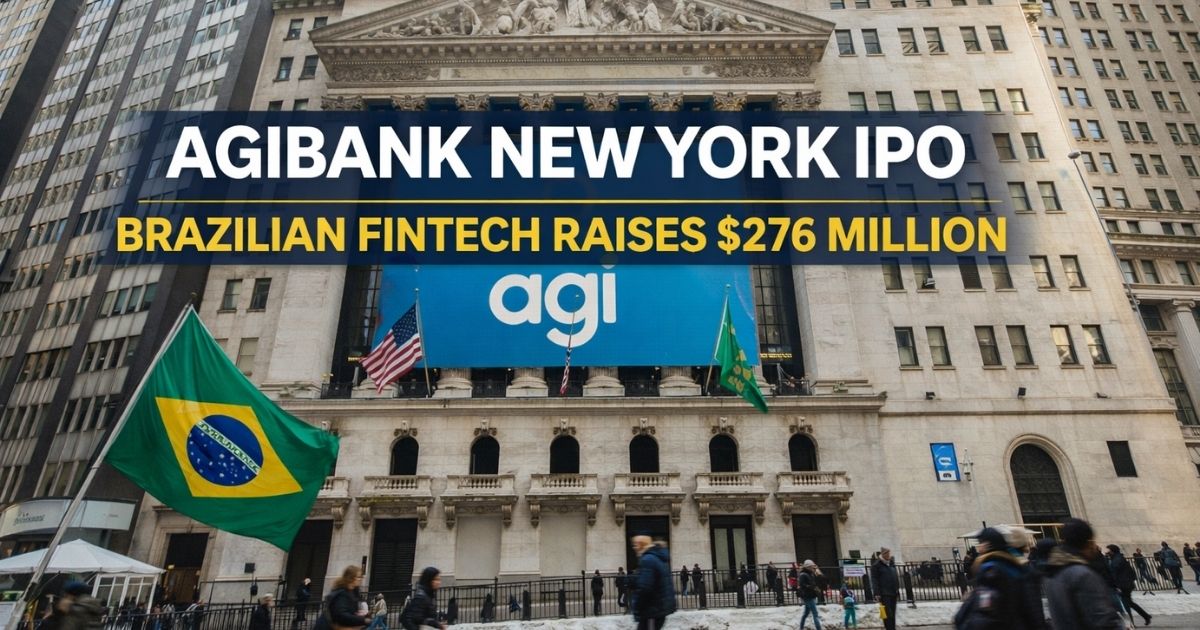
Agibank New York IPO priced 20 million shares at US$12 each, raising approximately US$276 million and securing an estimated US$1.9 billion valuation at its debut on the NYSE.
The São Paulo-based digital lender materially downsized its offering just hours before pricing, amending its F-1 registration statement with the U.S. Securities and Exchange Commission. The company reduced its original plan of 43.6 million shares at US$15–US$18 to 20 million shares at US$12–US$13 — a reduction of roughly 65% in anticipated proceeds.
The adjustment reflects a defining feature of the current U.S. IPO environment: valuation discipline now outweighs growth narratives.
Private Equity Exit Plans Were Scaled Back
The downsizing had direct implications for Agibank’s financial sponsors.
Two private equity investors — Vinci Partners and Lumina Capital — had been positioned to partially monetize their stakes through the IPO process. Once the offering was reduced and repriced, however, the expected secondary sell-down component was curtailed.
In effect, the Agibank NYSE listing became primarily a capital-raising transaction rather than a liquidity event for sponsors.
In stronger IPO cycles, private equity firms frequently use public listings as structured exit windows. In compressed markets, secondary components are often the first element to be reduced in order to preserve deal certainty and protect price stability.
The Founder and the Billionaire Milestone after Agibank Wall Street debut
Agibank was founded by Marciano Testa, who built the lender into one of Brazil’s most prominent payroll-deductible credit platforms.
According to Valor Econômico, Testa has been added this year to the list of Brazilian billionaires — underscoring the scale of value creation generated through Agibank’s expansion and now its access to Wall Street capital.
The Agibank Wall Street debut therefore represents both a capital markets milestone and a long-term wealth creation event for one of Brazil’s leading fintech founders.
Bookbuilding Mechanics and Investor Caution
The amendment to the registration statement came shortly before pricing, drawing attention in market commentary.

André Thiollier, partner at Foley & Lardner, told American Banker that the timing of the amendment is not unusual but that the size of the cuts could be more meaningful to investors. “Banks normally price and finish the book building by the night before the IPO debuts, because you want to have until the last second the ability to make sure you’re getting the right price,” he said.
What stood out was not the procedure, but the scale of the reduction.
Thiollier also emphasized broader caution among investors. “Given the window that we’re having and fewer IPOs even in the U.S., it sounds like investors are a little bit more cautious,” he said, “especially because we’re talking about a company that is focused on a single market in Brazil versus a more global market.”
He also contextualized the broader Brazilian fintech movement toward U.S. markets. “Brazil is one of the countries with the most fintechs in the world,” Thiollier said. “There are large companies taking this window to IPO in the U.S. market, which is something that we haven’t seen since Nubank.”
The Firms Behind the Deal
While full counsel attribution has not yet been comprehensively detailed in mainstream transaction coverage, the Agibank U.S. IPO reflects the standard cross-border legal structure for Brazilian issuers accessing American capital markets.
The transaction typically involves U.S. securities counsel advising on the F-1 registration statement and SEC compliance, Brazilian counsel addressing corporate governance and regulatory matters, international underwriters coordinating global distribution, and cross-border tax and capital markets structuring advisers.
Beyond the Law will update this section as additional SEC filings and deal summaries confirm issuer’s counsel, underwriters’ counsel, and participating firms.
Strategic Takeaway in Agibank NYSE Listing
The Agibank New York IPO signals that the U.S. fintech window remains open — selectively. Secondary sponsor exits are vulnerable in tighter valuation environments. Founder-led Brazilian institutions can still access Wall Street capital, but at disciplined pricing. In the current cycle, execution certainty prevails over maximizing headline valuation.
Related Reading in Agibank Wall Street debut
• PicPay U.S. IPO and Aftermarket Performance
• Brazilian Fintech Listings in U.S. Capital Markets
• Brazil fintech Agibank scales back IPO before US debut (American Banker, 02 10 2026)
Resumo em português
O IPO do Agibank em Nova York captou US$ 276 milhões após forte redução no preço e no tamanho da oferta. Fundos como Vinci Partners e Lumina Capital não conseguiram realizar a saída parcial esperada, reforçando o caráter mais conservador da operação.


Mevo Turns Prescriptions Into a Platform and Investors are Doubling Down with R$ 95 Million Round Equity Finance

Agibank’s New York IPO: Pricing Cuts Reflect a More Selective U.S. Fintech Window

A Defining Week for Latin America Tech: Brex, AI Infrastructure, and Market Maturity




Ticketmaster Acquires Brazilian BaladApp: What the Deal Means for Brazil’s Live-Events Market
Ticketmaster acquires BaladApp, advised by Mayer Brown; sellers represented by Bronstein Zilberberg.


Brazil’s Fintech Infrastructure: Pagaleve, Kanastra and Clash Are Rebuilding the Rails of Finance
Brazil's fintech infrastructure has digital payments Pix as its backbone


Enter Series A 2025: Founders Fund and Sequoia Back Brazilian AI Startup at R$2B Valuation
Enter raised $35M in Series A led by Founders Fund and Sequoia, valuing the Brazilian AI startup at R$2B.


The Associates: Partners Can’t Live Without
Introduction Partners often get the headlines, but behind every billion-dollar valuation or cross-border merger there is an associate making the...


Brazil AI Startups 2025: Venture Capital Rebounds After Pandemic Drought
Brazil AI startups rebound in 2025 after the pandemic drought. São Paulo startups like Omie, UME, and Unico show venture...